02 · Compression
730 hours per year
Imagine losing 91 full working days every year — not because you're absent, but because your body physically cannot maintain the pace.
What this means in practice
730 hours. That's the number of productive hours a heat-exposed worker loses every year in Nouakchott. Not because they choose to stop — because their body forces them to. Out of roughly 2,600 working hours in the year, 730 are absorbed by thermal stress.
For a vendor at the Capitale market, this means that on a 10-hour day in October, their body operates at full capacity for only about 6 hours. The other 4 hours, they're physically present, but their capacity is reduced. They slow down. They have to sit. They drink more water than they sell merchandise. This isn't laziness — it's thermoregulation.
For a mason on a construction site in the Arafat district, it's even more severe. The physical intensity is higher, the compression curve steeper. But even at the moderate intensity level we use — that of an active shopkeeper, not a construction labourer — the loss is massive.
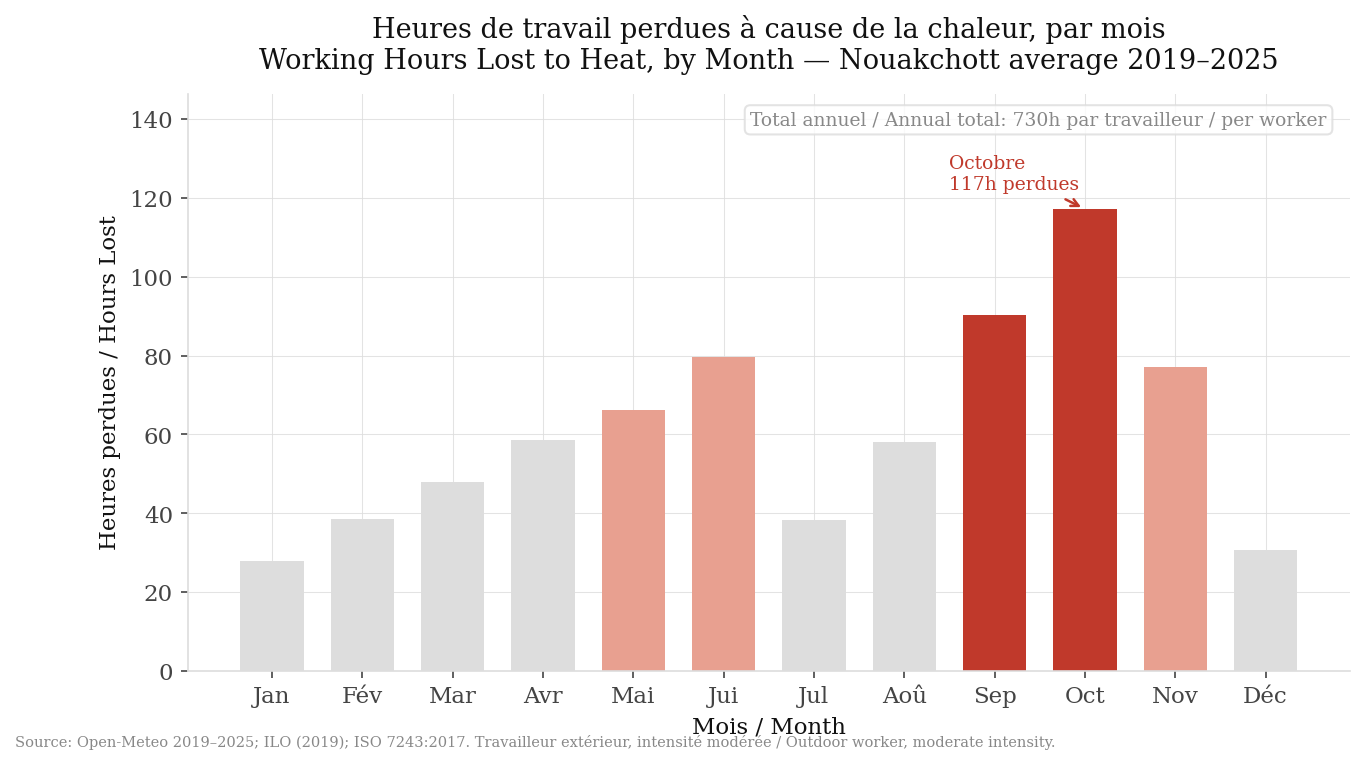
October loses 37.8% of capacity. January loses only 9%. The gap between the two defines the city's economic rhythm.
What it costs
To convert lost hours into money, we need a reference wage. The most conservative is Mauritania's minimum wage (SMIG): 3,000 MRU per month, or 36,000 MRU per year. But nobody earns exactly the minimum — it's a legal floor, not a typical income. So we use three scenarios.
The central scenario — 1.4 times the minimum wage — corresponds to a typical informal income for a market worker or artisan. At this level, heat costs each worker 14,742 MRU per year. That's 41% of the annual minimum wage. For a worker earning slightly above minimum, heat takes away the equivalent of nearly five months of minimum salary.
Why 120,000 workers?
That's our central estimate of heat-exposed workers in greater Nouakchott — those who work outdoors or in non-air-conditioned premises. This is conservative. Nouakchott's working population exceeds 300,000, and the majority don't have access to air conditioning at their workplace. We exclude those in air-conditioned offices, government administration, and formal services.
At the city scale
Multiply 14,742 MRU by 120,000 workers and you get 1,769 million MRU per year — roughly $49 million. That's income the city of Nouakchott doesn't generate because of heat. Not because people don't want to work. Because the climate won't let them.
These numbers count only the lost income of exposed workers. They don't count air conditioning — that's the other half of the equation, covered in the next section.
730 hours isn't an abstract number. It's the vendor who closes at 2pm because he can't hold out. It's the mason who stops at noon. It's the city running at half speed for five months a year.